
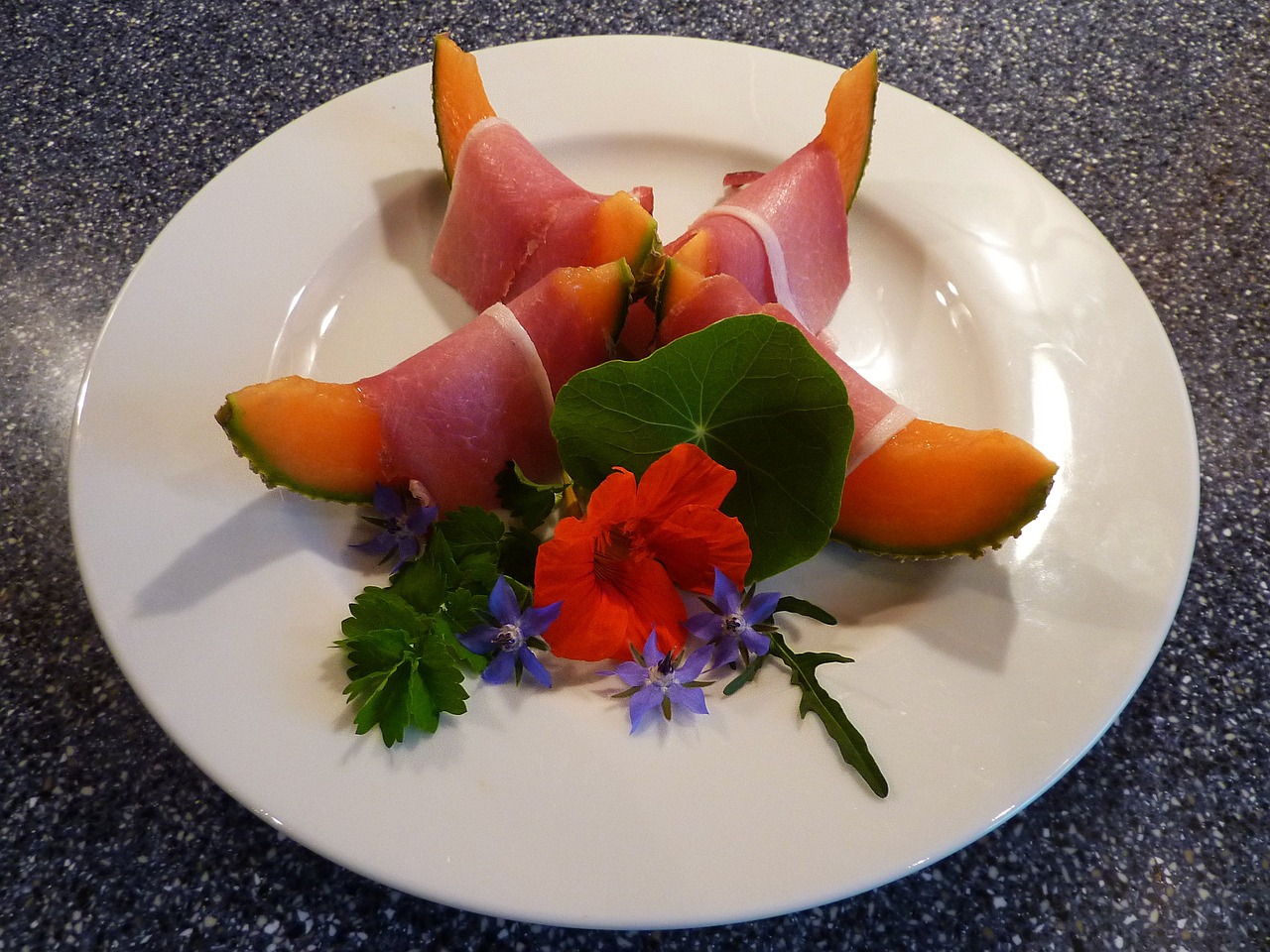
Borage is not native to the Southwest but it can be planted in your garden and foraged from your yard. There is also a cousin that is a native species and was once used by native peoples for food and medicine. We will look at both today.
Cover image is the edible flowers of borage and nasturtium served with melon and ham. More on edible flowers.
About Borage
Borage (Borago officinalis), also called starflower, and borraja in Spanish, is a plant best grown as a winter annual in most of the Southwest. It is a member of the Borage Family, the Boraginaceae. This plant comes to us as part of the Columbian Exchange and is occasionally found escaped and living wild around abandoned western towns. If you wish to grow your own – head on over to Grow Beautiful Borage on Gardening With Soule.

Borage Foods
Borage is used mostly as a fresh vegetable, edible flower, or a dried herb. As a fresh vegetable, borage, with a cucumber like taste, is often used in salads or as a garnish. Flowers have a sweet honey-like taste. Since they are one of the few truly blue-colored edible things, flowers are often used to decorate desserts or cold soups, like beet soup (borscht). Borage is also traditionally used as a garnish in the Pimms Cup cocktail, but is now often replaced by cucumber slices.

Vegetable use of borage leaves is common in Germany, in the Spanish regions of Aragón and Navarra, in the Greek island of Crete and in the Italian northern region Liguria. Although often used in soups, one of the better known German borage recipes is the Green Sauce (Grüne Soße) made in Frankfurt. In the Italian Liguria area, borage is commonly used as filling of the traditional pasta ravioli and pansoti. It is used to flavor pickled gherkins in Poland.

Select young tender leaves for eating. If you are growing this at home, flowering may start when the plant is still small. Just harvest the younger central leaves. The plant will make more.

Other Borage Uses
The recorded use of borage dates back to Roman times. It was a common winter vegetable in the warmer parts of the Roman Empire. Also, men would drink a tea made of the dried borage leaves mixed with wine for courage before battle.
In the time of Father Kino, borage was used to treat both internal and external inflammation, and to protect and soothe tissue. It was considered useful with respiratory problems where there is inflammation or irritation, such as a sore throat or cough, as well as for treating rheumatism. Borage was also used as a galactagogue, aiding milk flow in mothers with mastitis.

Today, herbalists use borage to aid in the reversal of the negative effects of adrenal fatigue, for regulation of metabolism and the hormonal system. The herb is considered to be a good remedy for PMS and menopause symptoms, such as hot flashes. The leaves of borage may be prepared as a tincture or as an infusion (tea) to alleviate and heal colds, bronchitis, and respiratory infections, and in general for its anti-inflammatory properties. Not only the leaves of borage, but also the flowers canbe prepared in infusions or as tinctures.

Borage Seed Oil
Borage is grown commercially as an oil seed crop. Not all seed oils have negative impact on the body. That whole “seed oils are evil” narrative refers to seed oils used in cooking. Borage seed oil is desired as source of gamma-linolenic acid (GLA, 18:3, cis 6,9,12-octadecatrienoic acid), for which borage is the highest known plant-based source (17 to 28 percent), a higher concentration than either evening primrose oil or black current oil.
This oil is often marketed as “starflower oil” or “borage oil.” Borage oil supplements have been shown in studies done in Germany to be beneficial for the treatment of rheumatoid arthritis. There is some use topically for treating chronic dry skin, such as in cases of eczema. Some herbal lotions created for eczema sufferers may contain borage oil.

Borage Cautions
Borage should be consumed in moderation. All parts of the plant contain small amounts of pyrrolizidine alkaloids.
Before you freak out about the whole alkaloids thing, remember that no plant wants to be eaten. Fruits are made to be eaten, so you will spread seeds, but not the rest of the plant. ALL plants contain something that is bad for humans to eat. It is why we constantly urge moderation in our posts.
Pyrrolizidine alkaloids (PAs), sometimes referred to as necine bases, are a group of naturally occurring alkaloids with a pyrrolizidine molecule as the center. One estimate shows that around three percent of flowering terrestrial plants contain PAs. Honey can contain pyrrolizidine alkaloids (from collected nectar), as can grains, milk, and even eggs. Humans have a long history of use of plants with PAs, generally as medicine, especially in Chinese, ancient European, and Native American traditions.

Harvest Borage
Borage flowers are produced fresh each day on a curling structure termed a scorpoid cyme. Ideally pluck individual flowers, leaving the structure behind to make more. These flowers can be tossed in salads, on top of soups, or candied and enjoyed as a dessert.
Borage seed can be harvested, then winnowed. They are often used in hot cereal, where the boiling water opens the seeds and releases the oils for absorption by the body. Seed can also be added to stir fry much like sesame seed. I tried some in our One Minute Mesquite Muffin instead of barrel fruit seed. It can be done, but it is easier to harvest and clean barrel seed.

Eat Your Weeds
The native plant that is cousin to borage is Amsinckia (am-sink-ee-ah), also called fiddleneck. The flowers are small and not at all flavorful like borage flowers. The young greens can be boiled and eaten like borage greens. The seeds can be harvested and used like borage seeds.

Older books record that the “Pima Indians of Arizona” harvested the above ground plant (stems and leaves) and rolled them in the sand to eliminate “thorns” before eating them raw. Roots were dried and used as a medicinal tea.
Savor the Southwest
Even if you never eat the plants we talk about, we do hope you will take a moment to stop, breathe – and savor the beauty of the Southwest.
A “Canuary” Guide
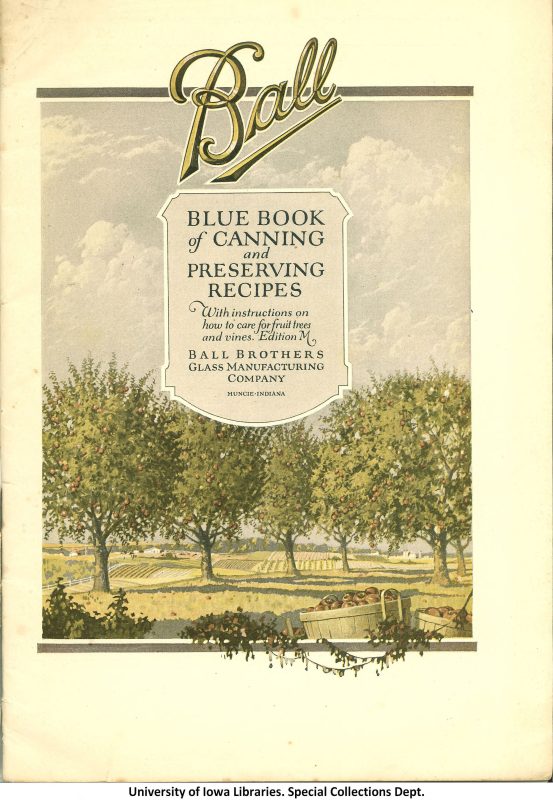
Ball Brothers has been publishing their “Ball Blue Book of Canning and Preserving Recipes” for many years. The copyright on this edition is expired, and many of the practices mentioned here are no longer considered valid by the USDA. However, if you are an experienced canner there are some tasty recipes in here to make. I love the Poached Pears. The Carolina Cole Slaw is also quite good. Disclaimer: This information is provided for your for entertainment purposes only.
This is sold as a downloadable PDF on my Gardening With Soule classes site. You may see some other classes in there that interest you.
Legal Notes
© Article copyright Savor the Southwest // Jacqueline A. Soule. All rights reserved. You must ask permission to republish an entire blog post or article. Okay to use a short excerpt but you must give proper credit. You must include a link back to the original post on our site. No stealing photos.
Disclaimer
The authors of this website have researched the edibility of the materials we discuss, however, humans vary in their ability to tolerate different foods, drinks, and herbs. Individuals consuming flowers, plants, animals, or derivatives mentioned in this blog do so entirely at their own risk. The authors on this site cannot be held responsible for any adverse reaction. In case of doubt please consult your medical practitioner.

Be the first to reply