

A tasty foraged find in March in the desert Southwest are the pods of jewel flower. This plant is native to a limited area of the Southwest, but when you find it in Arizona it is often nicely abundant.
Jewel Flower
And here is why we use scientific names! If you search for “jewel flower,” on the interweb, you will be confused. The web has at least 5 plants by that name, depending on where you live. You might also get lead to “jewelweed” which has lovely flowers but pods that explode to scatter seed. (Also, it is not edible at all!)
The web kept sharing the pin-up model Jewel Flowers. Quite the hottie in her day, her image graced the bunks, lockers, and even airplanes of many a WWII soldier.

Mustard Family Jewel Flower
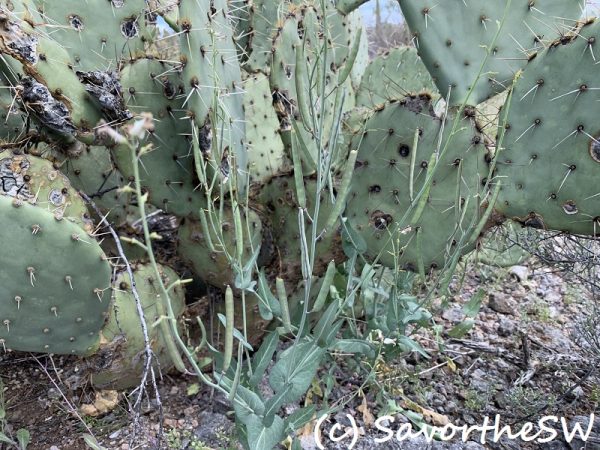
The jewel flower we are discussing is Streptanthus carinatus, a member of the mustard family. Jewel flower may also be called jewelflower (one word), twistflower, urn flower, or bell flower. All are good descriptors for the lovely little flower on this plant.
Jewel flower, like so many in the mustard family shares the trait that all parts are edible. In my opinion, not only edible but also highly palatable. The mustard family includes such common vegetables as arugula, broccoli, kale, and radish. By the way, the tender green pods of radish also make a tasty treat. So if you don’t forage some jewel flower pods, you could use radish pods, or even pea pods.
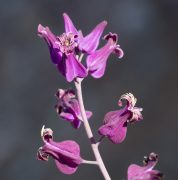
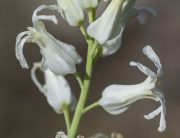
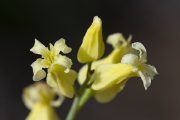 These three images of Streptanthus carinatus were taken and identified by the plant taxonomist Richard Spellenberg. This highlights how variable the species can be! Photos used here courtesy of R. Spellenberg.
Like many common names, “jewel flower” may be used for the entire genus, so note this if you are out collecting. The species that grow in Arizona and Nevada are one of about 35 species, and not considered rare. Move across the state lines however, and seventeen of the California species are classified as rare plants! Thus no harvesting in California unless you know your taxa!
Medical Nerd Note
 Like many members of the mustard family, jewel flower can be problematic if eaten to excess. There are a number of chemical compounds which give the mustard family its distinctive taste and occasional bitterness but most notable are the glucosinolates. Think of them as “mustard oils.”
Glucosinolates are considered goitrogens (goiter causing) or anti-thyroid agents. This is not supposed to be a problem given a healthy thyroid, and “adequate” consumption of iodized salt. In medical speak: “Dietary amounts of glucosinolate are not toxic to humans given normal iodine intake.”
Why does the plant even make these compounds? They do protect the plants from being eaten, especially by insects but by mammals as well. They are degraded with cooking, but most rabbits don’t have a handy cook stove to help break down the compounds, and help remove the bitterness.
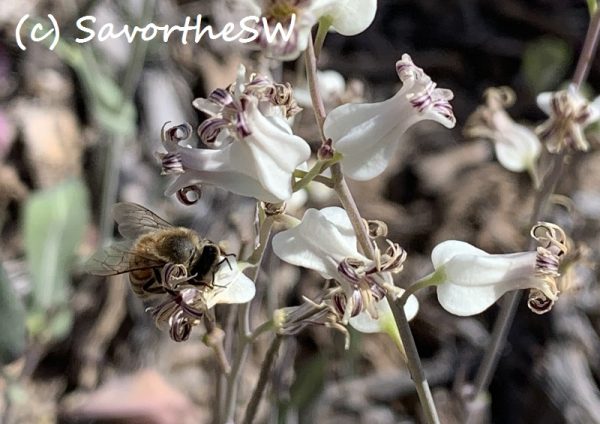
Now, here is Savorist Monica King (third generation bee keeper) with the rest of the story.
Jewel Flower = Bee Magnet
Bees adore jewel flower, which originally drew me, Monica King, to do more research. I was wanting to harvest the seeds to broadcast in my gardens at my main apiary. Multiple thick patches that I knew of had me frequenting the area and checking the green seeds pods for maturity. I really wanted some seed so I could grow it closer to home! Then I read that they are edible. I love foraging on my hikes!
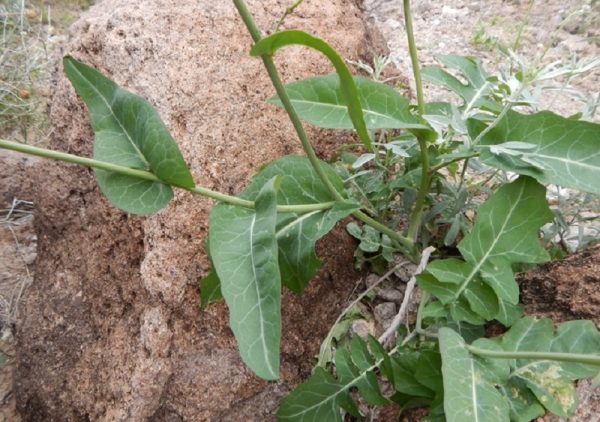
The area we live in had lush pockets of jewel flower from February through April – so we treated ourselves to snacks of the mustard flavored tender pods as we hiked. I also foraged some to take home to mix with snow peas from the garden.
Harvesting the Pods
In my haste to grab an ample amount for our dinner I did take a few too many of the older pods. These were more bitter and had a stringy vein. From now on I will reserve some patience for gathering and go for the younger, smaller pods. Generally these are closer to the top, near the flowers. Also, do take the time to treat them like pea pods – meaning remove the stems and de-vein them.
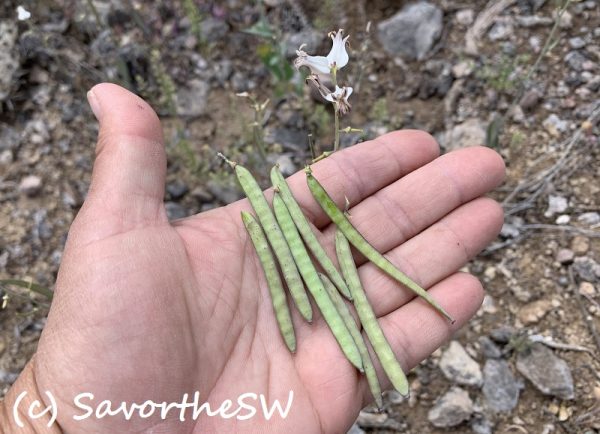
Sauteed Pods
With pea pods, the rule of thumb is 1/4 pound fresh pods for each serving. Aim for this with your jewel flower pods as well, but if you fall short – these are still a dandy side dish full of flavor.
Ingredients

     selection of fresh pods
          - or blend of jewel flowers and edible pod peas
     avocado oil or olive oil
     Kosher salt – roughly 1 teaspoon per pound
     black pepper – roughly 1/2 teaspoon freshly ground
          (helps highlight the peppery flavor)
Step 1. Remove and discard the stem end and string from each pod.
Step 2. Heat the oil in a large skillet or saute pan over medium-high heat. So not add the pods until the pan is hot or they will absorb the oil, rather than get sauteed.
Step 3. Add the pods, salt, and pepper.

Step 4. Cook, or technically, saute the pods. Turn, stir with a spoon – or if you are skilled – toss the pods occasionally for 3 to 5 minutes. You want the pods to be slightly limp – tender yet still crisp.
Step 5. Serve.
Pods are done – glistening and slightly limp but still with some crunch.
Enjoy!
Problem Bees?
 Bees may be swarming to a new home soon as the weather warms. Here is how to stay safe. (it’s in Resources section)
Got problem bees? Monica King does bee hive and swarm removals.
She does respond to text quickly, or you may email her. This information is available on our About Us page. (We redirect you not to annoy you but to appease the interweb AI bots that have rules about how posts should work. The Terminator did warn us that AI had behavior rules.)
Legal
© Article copyright Savor the Southwest // Jacqueline A. Soule// Monica King. All rights reserved. You must ask permission to republish an entire blog post or article. Okay to use a short excerpt but you must give proper credit. You must include a link back to the original post on our site. No stealing photos.
Disclaimer
The authors of this website have researched the edibility of the materials we discuss, however, humans vary in their ability to tolerate different foods, drinks, and herbs. Individuals consuming flowers, plants, animals, or derivatives mentioned in this blog do so entirely at their own risk. The authors on this site cannot be held responsible for any adverse reaction. In case of doubt please consult your medical practitioner.
Be the first to reply